Seven Chinese Ministries Issue Guidelines to Support Overseas Chinese Language Education
· 16 min de lecture · Texte original en anglais

Résumé rédigé par GACEE. Consultez l'article original pour le texte complet.
RubriquesActualités de l’enseignement du chinois
Recently, China’s Ministry of Education, the National Language Commission, the Central Propaganda Department, the Cyberspace Administration of China, the Ministry of Culture and Tourism, the National Cultural Heritage Administration, and the Communist Youth League Central Committee jointly issued the Opinions on Deepening the Inheritance and Development of Outstanding Chinese Language and Culture and Enhancing the Language and Cultural Literacy of the Whole Population (hereinafter referred to as the “Opinions”). The document outlines seven key tasks, with the seventh—“Deepening Exchanges and Mutual Learning”—explicitly stating: “Support the provision of overseas Chinese language education.”
The Opinions aim to foster the creative transformation and innovative development of outstanding Chinese language and culture; continuously enhance the language and cultural literacy of the entire population—especially young people; support the cultivation of a new generation capable of shouldering the historic mission of national rejuvenation; lay foundations for national language capacity building; serve the consolidation of the Chinese national community; advance the building of a human community with a shared future; and provide robust support for building a strong educational nation, a strong cultural nation, and a strong talent nation.
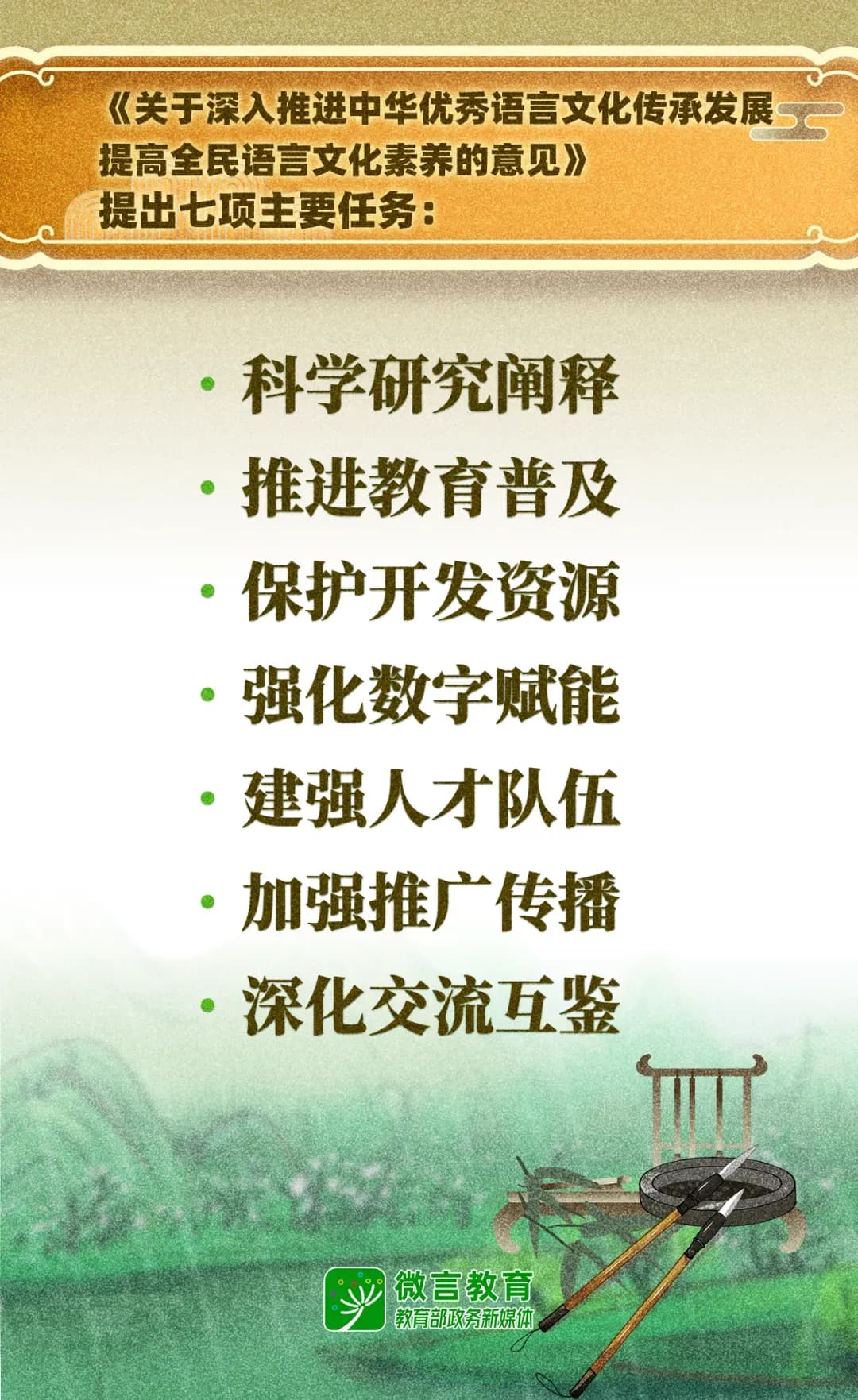
The Opinions set out seven principal tasks: first, scientific research and interpretation, calling for in-depth study and clarification of major theoretical and practical issues related to language and culture; second, promoting education and popularisation, proposing the implementation of major projects and initiatives to encourage innovation in teaching outstanding Chinese language and culture across regions, schools, and relevant institutions; third, protecting and developing resources, proposing strengthened governance of national language resources, systematic surveying, scientific protection, standardised archiving, open sharing, and service-oriented application of language resources—transforming linguistic advantages into cultural development advantages; fourth, strengthening digital empowerment, proposing accelerated digitisation of language and cultural resources, digital application of language and cultural achievements, and intelligent empowerment of language and cultural inheritance; fifth, building a competent workforce, proposing enhanced discipline construction in linguistics, incentives for language professionals, and recruitment efforts to cultivate, retain, and deploy research-oriented, application-oriented, and interdisciplinary language and cultural talents; sixth, enhancing promotion and dissemination, proposing accelerated development of a language and cultural communication system to strengthen the appeal, reach, and influence of outstanding Chinese language and culture; seventh, deepening exchanges and mutual learning, proposing the establishment of branded platforms for exchanging outstanding Chinese language and culture and creating new highlights in language and cultural cooperation.
The Opinions specify requirements for implementation. Local authorities, schools, and relevant institutions are required to intensify coordination, optimise resource allocation and expenditure structures, ensure adequate funding, and encourage diversified social participation. Publicity efforts must be strengthened to guide society in resisting undesirable linguistic phenomena, safeguard ideological and cultural frontlines, and foster a sound social ethos.
Read the full text of the Opinions below—
Opinions on Deepening the Inheritance and Development of Outstanding Chinese Language and Culture and Enhancing the Language and Cultural Literacy of the Whole Population
Language is a tool for exchanging ideas, a vehicle for transmitting civilisation, and a bridge for enhancing mutual understanding. A nation’s cultural appeal and ethnic cohesion are primarily expressed and conveyed through language. Outstanding Chinese language and culture—long-standing and rich in content—are an integral component of socialism with Chinese characteristics culture, a vital foundation for reinforcing the value-oriented role of culture in nurturing individuals, and an important support for fulfilling the fundamental task of moral and intellectual education. To thoroughly implement the deployment and requirements set forth in the Education Power Construction Plan Outline (2024–2035) regarding the implementation of national language and cultural inheritance and development projects and the enhancement of the whole population’s language and cultural literacy, the following Opinions are hereby issued.
I. General Requirements
Guided by Xi Jinping Thought on Socialism with Chinese Characteristics for a New Era, and thoroughly implementing the guiding principles of the 20th National Congress of the Communist Party of China (CPC) and its subsequent plenary sessions, comprehensively applying Xi Jinping’s thought on culture and his important instructions and remarks on education and language and culture, we must shoulder the new cultural mission of the new era, fulfil the fundamental task of moral and intellectual education, uphold socialist core values, intensify the promotion of Standard Chinese (Putonghua) and standardised Chinese characters, scientifically protect the languages and scripts of all ethnic groups, implement a series of national language and cultural inheritance and development projects, promote the creative transformation and innovative development of outstanding Chinese language and culture, generate more landmark outcomes, integrate them into school education and lifelong learning systems, incorporate them into education on fine traditional Chinese culture, revolutionary culture, and advanced socialist culture, and embed them in economic and social development. This will continuously enhance the language and cultural literacy of the entire population—especially young people—support the cultivation of a new generation capable of shouldering the historic mission of national rejuvenation, lay foundations for national language capacity building, serve the consolidation of the Chinese national community, advance the building of a human community with a shared future, and provide robust support for building a strong educational nation, a strong cultural nation, and a strong talent nation.
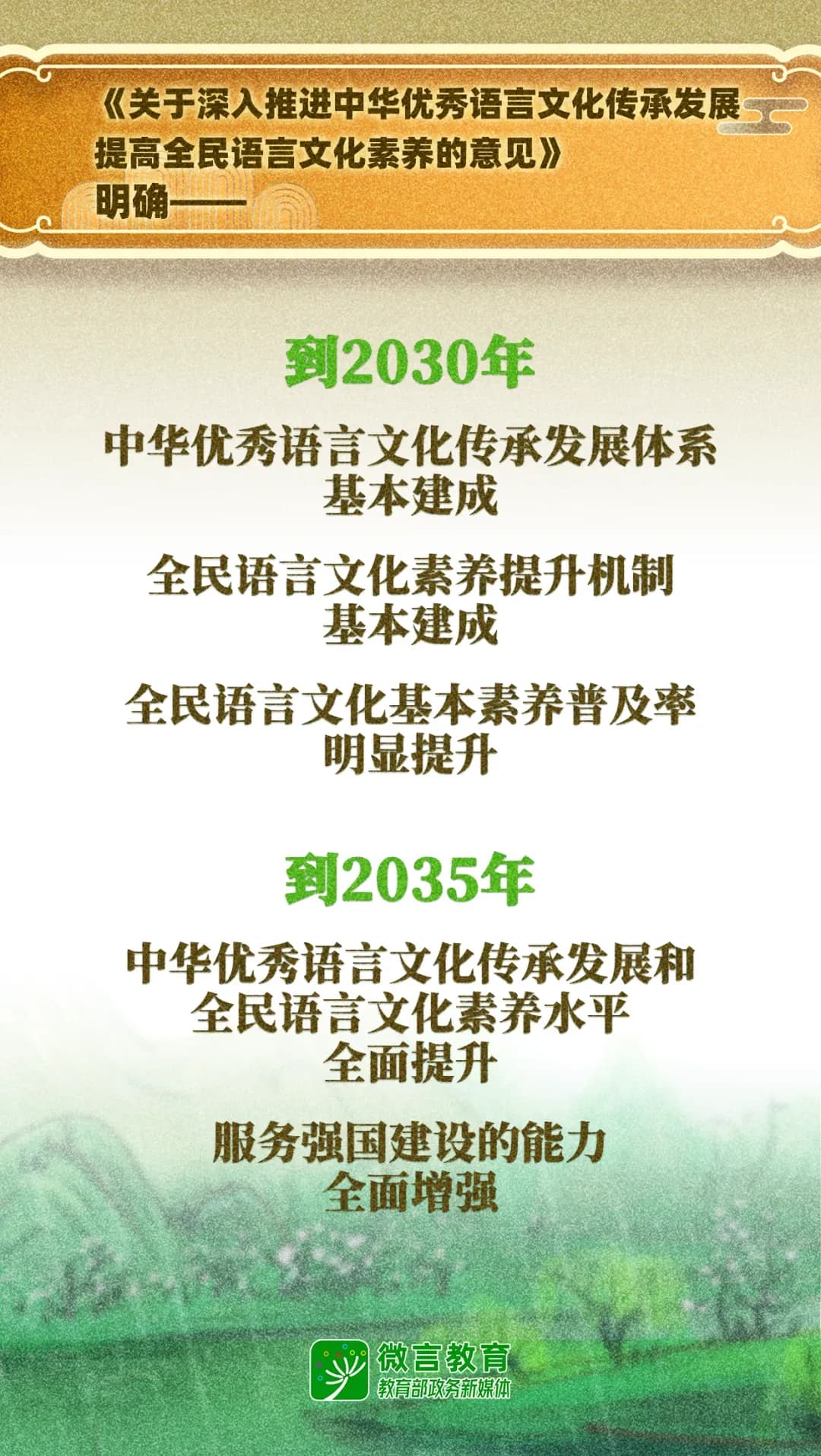
By 2030, a basic system for the inheritance and development of outstanding Chinese language and culture will be established, achieving coordinated progress in scientific interpretation, educational popularisation, resource development, digital empowerment, team building, promotion and dissemination, and exchanges and mutual learning; a basic mechanism for enhancing the language and cultural literacy of the whole population will also be established, with a marked increase in the coverage rate of foundational language and cultural literacy. By 2035, the level of inheritance and development of outstanding Chinese language and culture and the language and cultural literacy of the whole population will be comprehensively elevated, and their capacity to support national development goals will be significantly strengthened.
II. Key Tasks
(I) Scientific Research and Interpretation
Conduct in-depth research and interpretation of General Secretary Xi Jinping’s important instructions and remarks on language and culture, systematically elucidating the underlying principles, academic frameworks, and philosophical insights they contain, and better translating them into knowledge discourse, research paradigms, scholarly theories, and pedagogical content.
Deeply understand the fundamental requirement of “integrating the basic tenets of Marxism with China’s specific realities and with its fine traditional culture”, and research and interpret major foundational questions concerning language and culture raised by the Party’s innovative theories in the new era. Investigate the practical requirements for advancing education power construction, shaping new patterns for moral and intellectual education, and strengthening ideological and political guidance in relation to the inheritance and development of outstanding Chinese language and culture. Study and expound the intrinsic cultural connotations of Chinese language and script, their inherited Chinese genes, embedded national spirit, and embodied civilisational wisdom; scientifically clarify the intrinsic links between Chinese language and script and the distinctive features of Chinese civilisation; systematically uncover the historical origins and contemporary value of Chinese language and script; strengthen their unique functions—conveying ideas through language, transmitting spirit through speech, enriching wisdom through literature, and connecting roots through characters—and reinforce their foundational role in inheriting and promoting socialism with Chinese characteristics culture. Continuously produce signature achievements in outstanding Chinese language and culture to robustly support the construction of an independent knowledge system for Chinese philosophy and social sciences. Prioritise implementation of the Ancient Script and Chinese Civilisation Inheritance and Development Project, guiding society to deeply understand that oracle bone inscriptions constitute the root of fine traditional Chinese culture and that the formation and development of the Chinese nation cannot be separated from the unifying role of Chinese characters.
Scientifically interpret the profound implications of comprehensively promoting and popularising Standard Chinese (Putonghua), using linguistic connectivity to foster psychological and shared-future connectivity, and fully leverage the crucial role of outstanding Chinese language and culture education in consolidating the Chinese national community. Guide society to understand the developmental trajectory, core values, and global influence of outstanding Chinese language and culture, thereby continuously strengthening cultural identity with Chinese culture and supporting the construction of theoretical frameworks for the Chinese national community and the building of a shared spiritual homeland for the Chinese nation.
(II) Promoting Education and Popularisation
Innovatively deliver education in outstanding Chinese language and culture to effectively enhance the practical outcomes of language-based education, cultural nurturing, and moral cultivation. Prioritise implementation of the Chinese Classics Recitation Project and expand new categories and events within the Chinese Classics Recitation, Writing, and Speaking Competition. Vigorously implement the National Language and Cultural Literacy Enhancement Initiative, strengthen monitoring, feedback, and guidance on language and cultural literacy, and establish a language and cultural literacy index. Compile reading materials on outstanding Chinese language and culture and public-sector language etiquette guidelines. Conduct extensive popular education activities to guide the public in cultivating scientific awareness and attitudes, acquiring essential knowledge and information, mastering basic skills and methods, forming sound behaviours and habits, and upholding healthy aesthetic standards and social trends in studying and inheriting outstanding Chinese language and culture.
Encourage local authorities to improve long-term mechanisms for language and cultural education, integrating such education throughout the national education system and embedding it in urban and rural production and daily life. Support region-specific language and cultural education initiatives to sustainably raise public awareness of outstanding Chinese language and culture. Strengthen teachers’ capacity to deliver language and cultural education and leverage their exemplary leadership. Guide schools to innovate language and cultural education models, integrating such education into moral, intellectual, physical, aesthetic, and labour education; incorporating it into ideological and political courses and curriculum-based ideological education at primary, secondary, and tertiary levels; embedding it across disciplinary, teaching, and administrative systems; and coordinating value guidance, experiential practice, and environmental creation. Explore a holistic model for Chinese language and cultural education that integrates cognition, belief, and action; connects primary, secondary, and higher education; and fosters collaboration among families, schools, and communities. Promote studies tracing the evolution of Chinese characters—from oracle bone script and bronze inscriptions to seal script—and utilise ancient calligraphy, steles, cliff inscriptions, and other cultural relics to inherit calligraphy and seal carving—the gems of Chinese culture—as well as showcase ancient Chinese civilisational achievements such as printing and papermaking, alongside language and cultural education reflecting great accomplishments of the new era. Primary and secondary schools should make full use of language-based educational elements in curricula and textbooks, strengthen Putonghua instruction and standardised character writing, and innovatively conduct thematic lectures, study tours, and exhibition exchanges. Higher education institutions should offer public courses including College Chinese, Chinese Calligraphy, Digital Chinese, Digital Humanities, and Large Language Model Technologies, linking students’ language and cultural literacy development with subject-specific competence, occupational proficiency, and social adaptability. Encourage relevant institutions to launch language and cultural initiatives, and advocate for libraries, museums, cultural centres, and publishing houses to host language and cultural activities. Strongly promote language etiquette, civil language use, and language ethics to foster self-respect, self-confidence, rationality, calmness, positivity, and optimism in society, and support improvements in the public’s ideological-moral quality, scientific-cultural quality, and physical-mental health.
(III) Protecting and Developing Resources
Strengthen national language resource governance, harnessing the educational, technological, cultural, economic, security, and strategic value of language and script, and transforming linguistic advantages into cultural development advantages. Prioritise implementation of the China Language Resource Protection Project and improve the national language resource database to consolidate the foundational work of language resource construction.
Enhance the survey, collation, scientific protection, and standardised archiving of language resources; highlight the significance of oracle bone inscriptions’ inclusion in UNESCO’s Memory of the World Register; improve mechanisms for protecting and transmitting ancient scripts; implement the “Chinese Language Memory” Initiative, strengthening language resource protection within cultural ecology conservation zones and encouraging the establishment of urban and rural language and cultural archives. Promote the open sharing of language resources, focusing on extracting language-based educational resources from Chinese classics, revolutionary literature, and documents highlighting China’s achievements and experience; support schools in building language and cultural education environments; prioritise support for constructing the China Language Resource Museum, and encourage qualified localities and institutions to appropriately utilise historic buildings, industrial heritage sites, and campus facilities to develop language resource museums, language and script museums, and language and cultural parks; encourage urban and rural communities, transport hubs, and national cultural parks to build language and cultural landscapes; develop resources on Chinese characters and calligraphy and launch themed tourism routes. Strengthen service-oriented applications of language resources, relying on the National Key Sector Language Technology Empowerment Programme to support language and cultural inheritance and development; support the transformation and utilisation of language resources, language data, and language assets; support research and dissemination of language and culture in sectors such as time-honoured Chinese brands and geographical name intangible cultural heritage; and support language and cultural services targeting children, older adults, and persons with language impairments.
(IV) Strengthening Digital Empowerment
Implement the requirements of the Digital China initiative, fully unleashing the value of language and script data as a production factor, and promoting bidirectional empowerment between language and culture and scientific innovation. Rely primarily on the National Digital Chinese Construction Project to deepen integration between language and script and information technology, enhance artificial intelligence applications, and support the inheritance and development of outstanding Chinese language and culture.
Accelerate the digitisation of language and cultural resources, strengthening large-scale collection, annotation, standardised storage, and secure governance; improve quality evaluation mechanisms for corpus datasets; rely on the National Key Corpus Data Infrastructure Construction Programme to prioritise building corpora and databases for oracle bone script, classical and modern Chinese, and language and culture; implement the New Corpus Construction Project, improve related construction standards, and compile guidelines for typical applications. Accelerate the digital application of language and cultural achievements, improve the National Language Resource Service Platform and the China Language and Script Digital Museum, and support local construction of digital language resource platforms; promote breakthroughs in key technologies for ancient text digitisation; continue implementing the Chinese Character Font Excellence Project to enrich font libraries featuring works by masters of Chinese calligraphy across dynasties; construct digital public service products for language and culture, and support the development of the language digital industry. Accelerate intelligent empowerment of language and cultural inheritance, implement “AI+” language and cultural inheritance projects, and build domain-specific large language models; promote multichannel increases in the proportion, value orientation, and cultural contribution of Chinese in global digital spaces; establish monitoring mechanisms for large language model capabilities and literacy, guiding the public—especially young people—to use AI beneficially, safely, and fairly, and enhancing their discourse expression, value judgment, and cultural discernment capacities.
(V) Building a Competent Workforce
Build a language and cultural workforce that is sufficiently large, well-structured, and highly competent. Rely primarily on the National Language Capacity Construction Project to cultivate, reserve, and deploy research-oriented, application-oriented, and interdisciplinary language and cultural talents.
Intensify discipline construction in linguistics, support the implementation of the “Strong Foundation Programme” in ancient script studies, promote discipline development and the training of top-tier innovative talent in ancient script studies, and ensure continuity and succession in niche disciplines such as oracle bone script studies; support universities in exploring the establishment of language science programmes; promote integration between linguistics and related disciplines; support qualified universities in exploring talent development models combining “professional skills + language proficiency + cross-cultural competence”, facilitating the global outreach of Chinese culture. Intensify incentives for language professionals, establishing a chief expert system for major national language and cultural inheritance and development projects to cultivate leading figures in language and culture; rely on the National Language and Script Key Research Areas Navigation Programme to strengthen innovation teams in language and culture; and rely on existing professional platforms to elevate the expertise of teams engaged in curriculum and textbook development for language and cultural education. Intensify efforts to attract language professionals, implementing the National Language and Cultural Inheritor Programme to nurture “language resource guardians”, “language technology engineers”, and “language and cultural ambassadors”; build the brand of the “China Language Science Conference”, support the construction of a Global Language Service Platform, and organise China Language Competency Display Activities to attract high-calibre language and cultural talent.
(VI) Enhancing Promotion and Dissemination
Accelerate construction of a language and cultural communication system to strengthen the appeal, reach, and influence of outstanding Chinese language and culture. Prioritise implementation of the Chinese Language and Culture Communication Project, optimising communication concepts, innovating communication methods, and improving communication effectiveness.
Focus on building a language and cultural communication matrix, constructing the China Language and Culture Information Dissemination Platform, and innovating communication formats—including stage arts, audiovisual media, digital publishing, and micro-classes; scientifically construct the China Language and Culture Map to promote nationwide sharing of high-quality resources; support the establishment of institutions for inheriting outstanding Chinese language and culture, and effectively utilise nationally demonstrative, distinctive schools for language and script application and promotion; encourage hosting branded activities for inheriting outstanding Chinese language and culture, and develop digital premium courses, products, and case studies; run promotional campaigns such as “Elegant and Refined: A Good Word Every Day”. Aggregate high-quality reading resources, explore the construction of a reading standards system, deepen implementation of the Youth Student Reading Action, strengthen the building of “book-loving campuses”, and support nationwide reading initiatives and the construction of a “book-loving China”; conduct a series of activities including the “Glorifying China Through Classics” theme reading campaign, “Chinese Classics Nourishing Campuses and Homes”, and national campus festival-day recitation displays, and release exemplary cases and branded activities. Implement the “Same Roots, Same Heart” Language and Cultural Exchange Project for Hong Kong, Macao, and Taiwan, organising Chinese Classics recitation performances in Hong Kong and Macao and teacher training for primary and secondary schools, hosting the Cross-Strait and Hong Kong-Macao University Students’ Chinese Character Creative Design Competition, and effectively utilising the Cross-Strait Chinese Language Knowledge Base website.
(VII) Deepening Exchanges and Mutual Learning
Build branded platforms for exchanging outstanding Chinese language and culture and create new highlights in language and cultural cooperation to promote civilisational exchange and mutual learning. Prioritise implementation of the Chinese Ideological and Cultural Terminology Dissemination Project, constructing an interpretive system for Chinese ideological and cultural terminology that integrates classical texts, contemporary interpretations, and international expression, supporting the construction of China’s discourse and narrative systems.
Strengthen international Chinese language education, continuing to host the World Chinese Conference; expand the influence of internationally recognised Chinese language education brands such as “Chinese Bridge”, “International Chinese Language Day”, the “New Sinology Programme”, and the Hanyu Shuiping Kaoshi (HSK); support the Global Chinese Learning Platform and the Chinese Language Consortium; support the provision of overseas Chinese language education; promote the application of Chinese in international organisations, economic and trade exchanges, science and education cooperation, and people-to-people exchanges, increasing the real-world usage ratio of Chinese globally. Develop and aggregate multilingual resources telling China’s stories, enabling more language and cultural masterpieces to go global and contributing public cultural products to the world; implement the Multilingual Digital Global Dissemination Programme for Outstanding Chinese Cultural Courses, vividly narrating China through language and culture; implement the Overseas Dissemination Project for Chinese Classics, conducting Sino-foreign youth study exchanges, overseas teacher training, and Chinese classic recitations by international students; focus on major initiatives such as high-quality Belt and Road cooperation to conduct international language and cultural exchanges and effectively communicate China’s voice; actively cooperate with international organisations such as UNESCO and proactively participate in global language governance, contributing China’s strength.
III. Implementation and Organisation
Strengthen CPC leadership over the inheritance and development of outstanding Chinese language and culture, ensuring Party leadership permeates all aspects of work and guarantees the correct political direction. The Ministry of Education, the National Language Commission, the Central Propaganda Department, the Cyberspace Administration of China, the Ministry of Culture and Tourism, the National Cultural Heritage Administration, and the Communist Youth League Central Committee, together with relevant departments, shall coordinate national language and cultural inheritance and development work, establishing multi-departmental collaborative mechanisms and regional expert guidance mechanisms. Local authorities shall incorporate language and cultural inheritance and development work into their development plans, formulate special implementation plans, and clarify task assignments; integrate such work into sectoral management, urban-rural management, and the construction of civilised cities, towns, units, and campuses; and organically embed it into school performance evaluations and students’ comprehensive quality assessments. Local authorities, schools, and relevant institutions shall intensify coordination, optimise resource allocation and expenditure structures, ensure adequate funding, and strengthen diversified social participation. Implement the Regulations on the Use of Standard Chinese and Standardised Characters in Information Technology Products, standardise language and script usage across all new media platforms, strengthen governance of online language and script, and build a healthy, civilised online language environment. Increase publicity efforts to guide society in resisting undesirable linguistic phenomena, safeguard ideological and cultural frontlines, and foster a sound social ethos.
Ministry of Education
National Language Commission
Central Propaganda Department
Cyberspace Administration of China
Ministry of Culture and Tourism
National Cultural Heritage Administration
Communist Youth League Central Committee
16 December 2025
Infographic | Xun Ning
Source: https://mp.weixin.qq.com/s/YGrfWWl03OGWcc2NZf3igA · Lire l'article original ↗